
Choosing a Program
Laser Courses in BC: What the Training Covers and How to Choose
Published November 1, 2026 · Legends Academy · Abbotsford & Langley
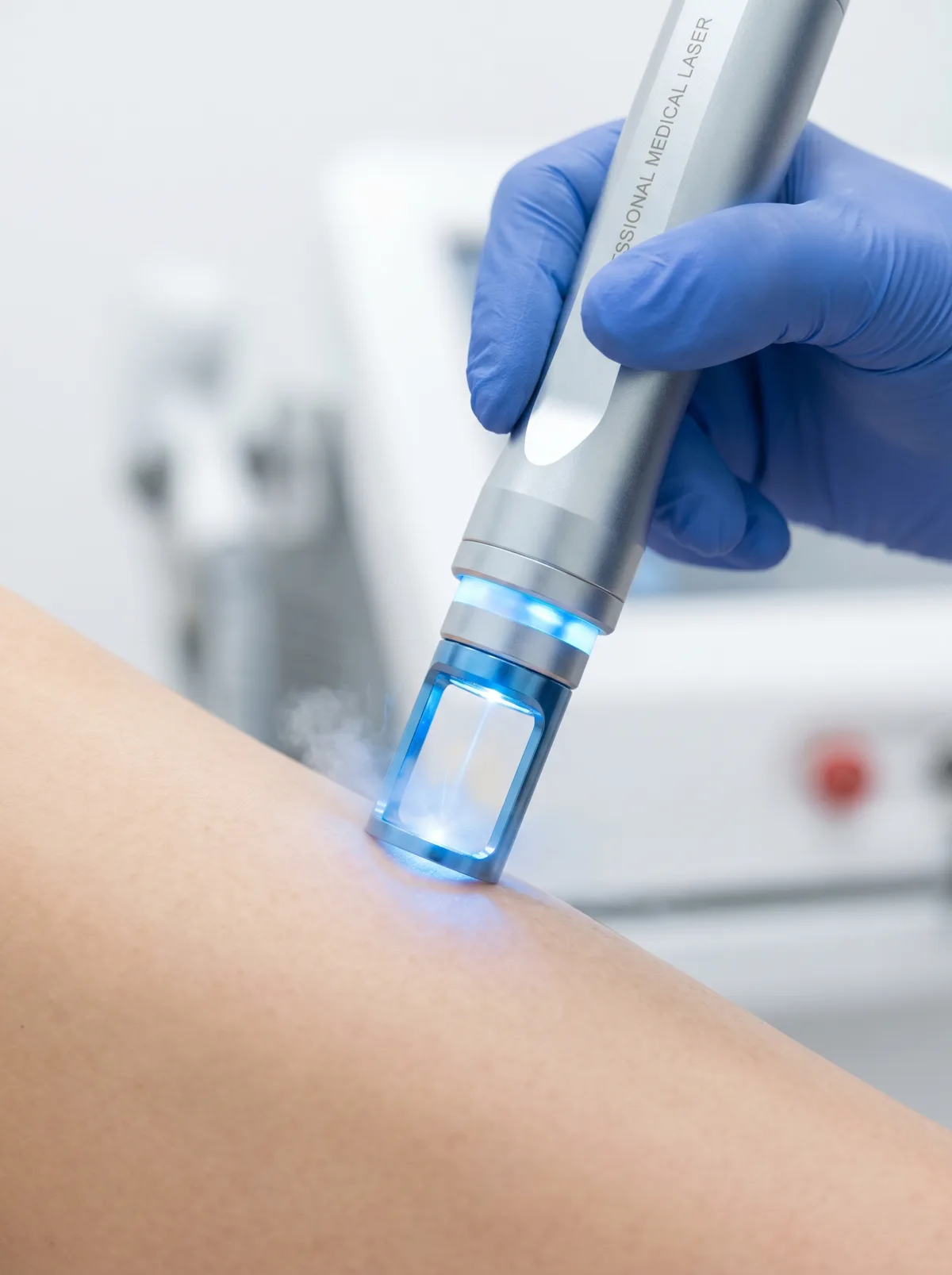
A good laser course in BC teaches you how laser and light devices act on skin and hair, how to assess each client before you treat them, and how to keep a treatment room safe. Approved laser programs in BC’s private school directory run from about 20 hours to more than 1,000, so the name on a course tells you very little about what is inside it.
At Legends Academy, Medical Esthetics Laser is 1,060 hours over 48 weeks and includes the full Esthetics program.
This article is for people who want to learn the work. To book a treatment instead, our laser services are on the client services page. For licensing and what “RLT” means, read laser technician requirements in BC.
Laser training at Legends Academy, at a glance
Medical Esthetics Laser
- Length
- 1,060 hours over 48 weeks (11.5 months)
- Credential
- Diploma
- Program fees
- $21,152 before GST/PST
- Starting point
- Includes the full Esthetics program
- Next intake
- Feb 2, 2027
$18,500 tuition, $150 registration and $2,502 for textbooks, kit and supplies.
All fees are before GST/PST, and tax applies to textbooks, kit and supplies. The funding page sets out how students pay. Start the conversation with us and we'll help you through the process.
What a laser course teaches
A client books laser hair removal on her upper lip. She has just come back from a holiday with a tan, she gets cold sores, and she wants to know how many sessions it will take. Treating her well starts before the device is switched on, and it may start with telling her to come back another day. Health Canada names both a tan and a history of cold sores in the treatment area among the things to check.
Its safety guidelines for laser hair removal list the rest: skin type, hair colour, thickness and location of the hair, previous hair removal methods, the wider medical history, and tattoos or moles in the treatment area. They also call for a patch test before full treatment. A good course should prepare you for that conversation, and we would look for four things in it.
How light behaves in skin
A hair removal laser sends pulses of infrared radiation through the skin to the melanin in the hair follicle, where the heat destroys the hair. Melanin also colours the skin, which is why, in Health Canada’s words, “fair-skinned individuals with dark hair are more easily treated; for people with naturally dark skin and/or tanned skin it is more difficult.” The Nd:YAG, the diode and the alexandrite are the typical lasers it names, and it says intense pulsed light and radio-frequency devices “operate on the same basic principle.”
Reading the client in front of you
Much of the skill is in the decisions made before the first pulse. A course should teach you the medical history to take, the pre-treatment instructions to give (no tanning, plucking, waxing or electrolysis), and how to explain results honestly. Most people need several sessions. Health Canada’s consumer page, first published in 2004, says that depending on the operator and the laser system, “there may be some permanent hair reduction (about 30%),” and that the procedure may not work for every person or on every part of the body. The 2011 guidelines list side effects from pain, redness, swelling and blistering to, rarely, permanent skin pigment changes or scarring, so a client needs to hear about them from you first.
Keeping eyes safe and preventing fires
Health Canada’s 2011 guidelines describe the lasers then used for hair removal in Canada as class 3B or 4, the highest hazard classes. Protective eyewear must be labelled with the same wavelength the laser emits, and Health Canada reports that “70 % of laser eye accidents resulted simply because available protective eyewear was not worn, or inappropriate/damaged eyewear was worn.” Fire is part of the same lesson, because a beam can ignite flammable or combustible materials.
Running the room
Health Canada’s guidelines list these topics for laser safety training: fundamentals of laser operation, responsibility for safety, laser classification, potential hazards including reflections, control measures, care of protective equipment, medical surveillance, pre- and post-treatment patient care, and emergency procedures. Each facility should also have a Laser Safety Officer, a person authorized by the owner to run the safety program, and keep records of each operator’s qualifications and training.
Use that list as a benchmark for comparing courses. It is guidance, as the guidelines say themselves: “While compliance with the requirements as stated in this document is voluntary, there are regulatory requirements governing the use of lasers in each province and territory.” They also date from 2011, so use them to test a course outline, and check current rules with the bodies named below.
Why laser courses in BC differ in length
Two courses can both be called laser training and differ in almost everything else. The directory of private schools shows four differences.
The hours differ widely
We read the Private Training Institutions Regulatory Unit (PTIRU) directory on October 31, 2026. Leaving aside one 5-hour teeth whitening course, approved programs with “laser” in their names ran from 20-hour technician courses to diplomas of more than 1,000 hours.
Different starting points
A long diploma can include a whole esthetics education, while a short course can assume you already have one. Our Medical Esthetics Laser includes the full Esthetics program.
One treatment, or many
Program names in the directory range from a single treatment, such as hair reduction or tattoo removal, to full medical aesthetics diplomas. Compare what each one teaches, as well as the total.
Similar hours, different calendars
Timetables change the calendar. In the same directory, one laser program of 673 hours is listed at 19 full-time weeks, and another of 714 hours at 34.
So when one course looks far shorter or cheaper than another, find out what you would need to already know before it starts, what you would be trained on, and where that training can be used.
What BC’s rules say about laser training
Whether you need a licence is covered in our requirements article. The narrower question here is what the rules say about training. The Province lists cosmetic laser services among its examples of personal service establishment services, and the Regulated Activities Regulation prescribes the operation of a personal service establishment as a regulated activity. That brings in section 18 of the Public Health Act: “An operator who is an employer must ensure that employees are adequately trained and sufficiently equipped to recognize, prevent and respond to health hazards that may arise when engaging in a regulated activity.”
The Province’s laser guidelines for owners and operators, written in 2005 and adopted in 2011, are a reference public health officials may use, and they are more specific: “Those using or working in the vicinity of class 3b or 4 lasers must have received detailed laser safety training appropriate for the safe use of their laser.” WorkSafeBC adds a workplace rule, section 7.23 of its regulation: equipment producing non-ionizing radiation must be installed, operated and maintained in accordance with listed standards, which include ANSI Z136.1, Safe Use of Lasers.
So a course is a foundation. Notice the words “their laser” in the Province’s line. Health Canada says operators should also refer to the user information from the manufacturer or distributor of their equipment, along with any training materials. A licensed device comes with an operator’s or training manual.
Seven questions to ask any laser school
Take these to every tour, ours included.
- 01
How many hours, on what timetable, and how many of those hours are on a laser?
A total does not tell you how much of the course is on a device. PTIRU says the enrolment contract for an approved program must include the start and end dates, hours of instruction and the credential granted, along with a copy of the program outline. Ask to read the outline before you sign anything.
- 02
Which devices will I train on, and are they licensed in Canada?
Ask for the names, then ask about the licence. Health Canada tells clients to make sure a device “has been licenced by Health Canada for the specific procedure you have in mind”, and says the licensed uses are described in the manual supplied by the manufacturer. Ask to see that manual too.
- 03
Who teaches laser safety, and is my training documented?
Walk through the Health Canada topic list above and ask where each one is taught. Then ask what record you leave with. Health Canada’s guidelines say “all training activities must be documented by the owner and retained on file,” so you will want a clear record of your own.
- 04
When do I work on clients, and who is beside me?
Ask when students move from theory to treating people, how many treatments you will perform, and on which skin types and body areas. Patch testing and skin assessment are hard to learn from a book, so ask who watches you do them.
- 05
Which treatments does the course cover, and who is allowed to perform each one?
Ask this about every treatment taught, and ask where each one can be offered.
- 06
Is the school designated and the program approved, and what are the fees and refund terms?
The PTIRU directory shows whether a school is certified, which type of certificate it holds, and whether a program is approved or does not require approval. PTIRU explains why that matters: “only students enrolled in approved programs are eligible to make a claim on the Student Tuition Protection Fund in the event that your institution ceases to hold a certificate or misleads you regarding your program.” Its checklist also tells you to confirm program costs and the tuition refund policy. PTIRU also says institutions must not charge more than $250 for a domestic student application fee or $500 for an international one.
- 07
Can I talk to current or former students, and see where laser is taught?
PTIRU’s own advice for choosing a private school includes visiting the institution if possible, talking to current or former students, and researching comparable programs. Use the tour to check the things you have just read about.
Laser training at Legends Academy: inside the program
Medical Esthetics Laser is the full Esthetics program with complete hands-on practical work on the laser and light platform. The services it trains are manicure, pedicure, artificial nails, waxing, body massage and treatments, makeup, facial skin care, radio frequency, contouring, IPL and hair removal, among others listed on the program page. Theory runs from infection control, anatomy, skin histology, chemistry and electrotherapy to communicating with the laser client, pre- and post-treatment care, and the physics of light therapies and contraindications. You finish with an Esthetics diploma including laser therapy. The program uses Milady’s Standard Laser and Light Therapy textbook.
The program includes applying newly learned skills to clients under expert oversight.
How to choose a laser course
Start with where you are today. Without esthetics training, check whether each course will admit you and what it would prepare you to do. With a diploma already, you can compare shorter courses, and the questions above will show you which ones give you time on a device. Then think about which treatments you want to learn, because a hair removal course and a full medical aesthetics diploma are different commitments.
Then go and stand in the room, because a website cannot show you the equipment. Ask to see where laser is taught at every school you visit. Read the label on the eyewear and ask how it matches the device. Look for the warning sign at the door. Ask who the Laser Safety Officer is and how you would be corrected when you get a setting wrong.
Questions before you apply?
Talk to an admissions advisor
Cost, funding, start dates, what a school day looks like: ask anything. Choose your campus and an advisor will call you back at a time that suits you.
Or call now: Abbotsford 604-859-5777 · Langley 604-530-4678
Common questions
What do you learn in a laser course in BC?
A good laser course in BC teaches how laser and light devices act on skin and hair, how to assess a client before treatment, and how to keep the treatment room safe. Health Canada’s list of safety training topics includes laser fundamentals, classification, hazards, control measures, pre- and post-treatment patient care and emergency procedures. Read the program outline to see how much of the course is hands-on.
How long is a laser course in BC?
Laser courses in BC range from about 20 hours to more than 1,000 hours, based on approved programs with “laser” in their names in the PTIRU directory on October 31, 2026, leaving aside one 5-hour teeth whitening course. At Legends Academy, Medical Esthetics Laser is 1,060 hours over 48 weeks (11.5 months).
Can I take a laser course without esthetics training?
Whether you need esthetics training first depends on the course, so check its admission requirements. At Legends Academy, Medical Esthetics Laser includes the full Esthetics program alongside the laser training.
How much does Medical Esthetics Laser cost at Legends Academy?
Medical Esthetics Laser at Legends Academy costs $21,152 before GST/PST: $18,500 tuition, $150 registration and $2,502 for textbooks, kit and supplies.
Does laser training cover IPL?
Whether a laser course covers IPL depends on the school, so check the outline. Health Canada groups lasers, intense pulsed light and radio-frequency devices together as working on one principle. At Legends Academy, Medical Esthetics Laser includes IPL and radio frequency.
When does the next laser program start at Legends Academy?
The next Medical Esthetics Laser intake at Legends Academy is Feb 2, 2027.
Sources
- Health Canada — Laser Hair Removal: Safety Guidelines for Facility Owners and Operators (First Edition, October 2011)
- Health Canada — Cosmetic Laser Treatments (original April 2004; page date March 18, 2021)
- Province of BC — Personal service establishments
- Province of BC — Laser Hair Removal Devices: Safety Guidelines for Owners/Operators (written 2005, adopted September 2011)
- BC Laws — Public Health Act, section 18
- BC Laws — Regulated Activities Regulation
- WorkSafeBC — OHS Regulation Part 7, section 7.23
- PTIRU — Be an informed student
- PTIRU — Private Training Institutions Directory
Sources retrieved October 31, 2026. Regulation of cosmetic laser use differs by province and changes over time, and the directory and the bodies named above can update their requirements. Confirm the current position with them before you make decisions based on this page. This is general information, not legal advice.
Visit our Abbotsford or Langley campus
Bring the seven questions to #7 32700 George Ferguson Way in Abbotsford or 20585 Fraser Hwy in Langley, and hold us to them. The next Medical Esthetics Laser intake starts Feb 2, 2027. When you are ready, admissions can walk you through applying.